Colours & Gradients
Table of Contents
Colour definitions
The specified colour definitions are binding. Any other colour representations are not permitted.
- Colour mode CMYK: Colour separation into the primary colours cyan, magenta, yellow and black (for contrast). Used for offset and digital printing (brochures, catalogues, leaflets, advertisements, packaging, etc.).
- Colour mode RGB: Colour separation into the screen display colours red, green and blue. Used for Word, Excel and PowerPoint files as well as all on‑screen applications (website, newsletters, email signatures, etc.).
- PANTONE: An internationally standardised colour system for all areas of print production (offset printing, digital printing, screen printing, flexographic printing, etc.) on uncoated (U) and coated (C) papers and boards.
- RAL: An international colour system for paints, exterior colours and technical coatings (façade paints, lacquers, powder coatings, etc.).
Colour gradients
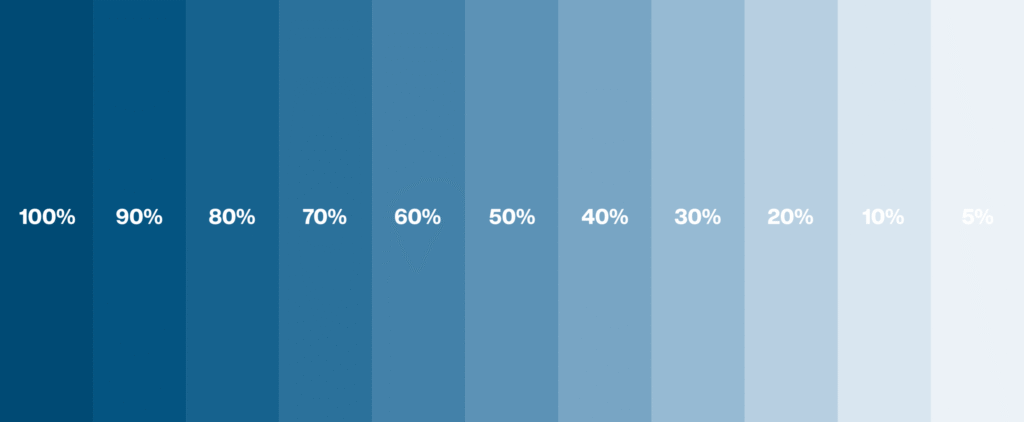
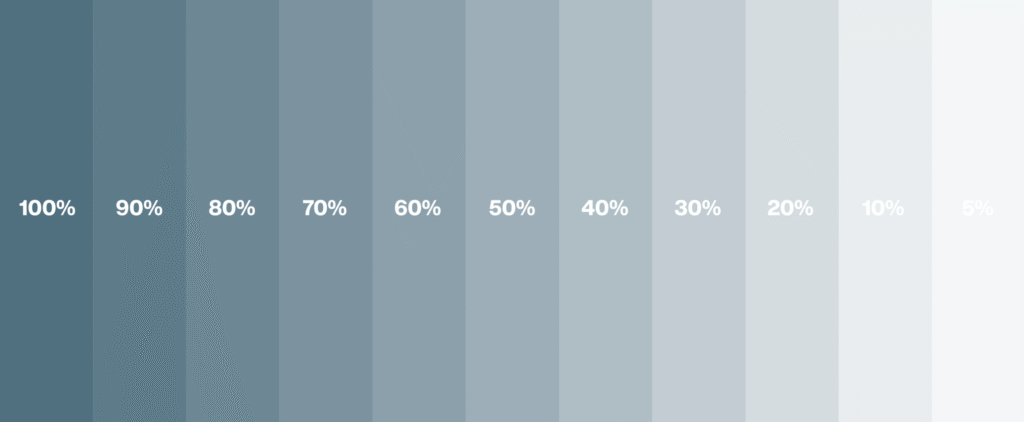
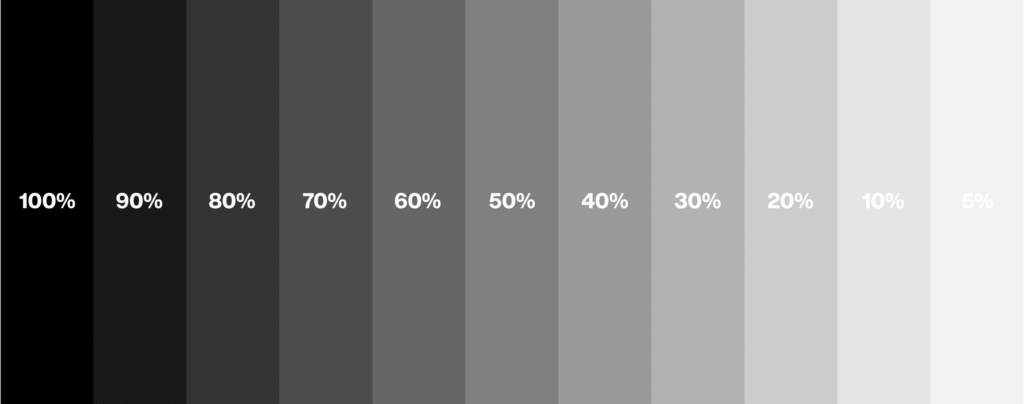
The primary colours may be used in 5% increments of the colour value, for example for table backgrounds or exhibition stands.
Primary colours
POLOPLAST Blue

| CMYK | 100 / 40 / 0 / 50 |
| RGB | 0 / 74 / 116 |
| HEX | #004a74 |
| Pantone | PANTONE 7693 C |
| RAL | 5003 Sapphire Blue |
Pure Progress Gray

| CMYK | 60 / 40 / 30 / 25 |
| RGB | 100 / 116 / 132 |
| HEX | #647484 |
| Pantone | PANTONE 7545 C |
| RAL | 7031 Blue Gray |
Black

| CMYK | 0 / 0 / 0 / 100 |
| RGB | 0 / 0 / 0 |
| HEX | #000000 |
| Pantone | PANTONE Process Black C |
| RAL | 9005 Jet Black |
White

| CMYK | 0 / 0 / 0 / 0 |
| RGB | 255 / 255 / 255 |
| HEX | #ffffff |
| RAL | 9003 Signal White |
Secondary colours
An extended colour spectrum is available for the creation of colour gradients and design elements. These colours may be used in addition to the primary colours. Colour gradients as used for the primary colours are not intended.
POLOPLAST River Blue

| CMYK | 75 / 15 / 0 / 0 |
| RGB | 0 / 165 / 223 |
| HEX | #00a5df |
| Pantone | PANTONE 2925 C |
POLOPLAST Nature Green

| CMYK | 50 / 5 / 100 / 0 |
| RGB | 149 / 187 / 32 |
| HEX | #95bb20 |
| Pantone | PANTONE 376 C |
POLOPLAST Alpine Mint

| CMYK | 70 / 20 / 70 / 5 |
| RGB | 86 / 148 / 97 |
| HEX | #569461 |
| Pantone | PANTONE 556 C |
Gradients
Gradients may be used across a variety of applications. They are primarily used when incorporating campaign imagery within the ring. In addition, gradients may be applied as a coloured background for the ring, on exhibition stands, or for full‑surface colour applications.
Four main gradients
There are four main colour gradients. All use POLOPLAST Blue as the base colour, combined either with the secondary colours or with POLOPLAST Blue at 40% tint.




*) Sustainability gradient
The green‑blue gradient is used exclusively in the context of content with a sustainability‑focused communication emphasis.
Additional gradients
If applications require further gradients beyond the four main gradients, these alternative gradients may be used.
In this case, Pure Progress Grey, a lighter tint of POLOPLAST Blue, or a 40% tint of black may be used as the secondary colour in combination with POLOPLAST Blue.



Background gradients
For the use of gradients as backgrounds or when the ring is applied as a background element, tonal variations of POLOPLAST Blue, Pure Progress Grey, black and the secondary colours may be used in exceptional cases in 5% increments. In doing so, it must be ensured that the tonal values of the respective colours remain below 25%.